Why
To claim territory
Tagging is an attempt by individuals or groups to assert their control over an area. Organized criminal organizations, like street gangs, use tags to warn competitors to stay away from areas where they sell drugs.
A proven, quiet, community-run method for keeping neighborhood walls clean — and keeping the taggers from coming back.
Tagging is the practice of writing a nickname or mark on a surface — most often on public walls, utility boxes and buildings along the streets you already walk.
Tagging is an attempt by individuals or groups to assert their control over an area. Organized criminal organizations, like street gangs, use tags to warn competitors to stay away from areas where they sell drugs.
The occasional bold tagger works in daylight, but most tagging happens in the early morning hours after the bars close and the streets and parks are relatively empty.
You'll rarely see a tag inside a public restroom. Most taggers leave their mark on surfaces commonly found in the open — city streets, parks and any blank vertical surface visible to passersby.
Most taggers focus on vandalizing areas with unusually high foot traffic — to increase the odds the public will see their mark. Any blank vertical surface is a canvas waiting for their mark.
Popularized by James Q. Wilson and George Kelling, the theory suggests that even minor signs of disorder — broken windows or graffiti — create an environment where more serious crimes become more likely.
Graffiti signals a community is uncared for, or that enforcement isn't active. That can lead to a perception of lawlessness and encourage further antisocial behavior.
Studies show proactive graffiti removal correlates with reductions in vandalism, burglary and even violent crimes.
Austin PARD removes tags from City parks — but Texas law requires property owners to keep their premises free of graffiti.
When it comes to removing tags, property owners have a choice: learn to safely remove tags themselves, or hire experts. Both are expensive. Most delay or do nothing.
Expert graffiti removal is expensive and property owners rarely prioritize it. So they delay removing tags themselves — or simply refuse to remove them at all.
Inactivity encourages other taggers to leave their marks. Word spreads across the city. Left unchecked, they'll mark every surface available — vastly increasing the property owner's eventual removal cost.
Some contractors save money by using muriatic acid or grinders — permanently damaging surfaces. Others pressure-wash without reclaiming the contaminated water, as required by law.
Over years of work in East Zilker, we've developed and proven a method to remove graffiti from a neighborhood and prevent its return.
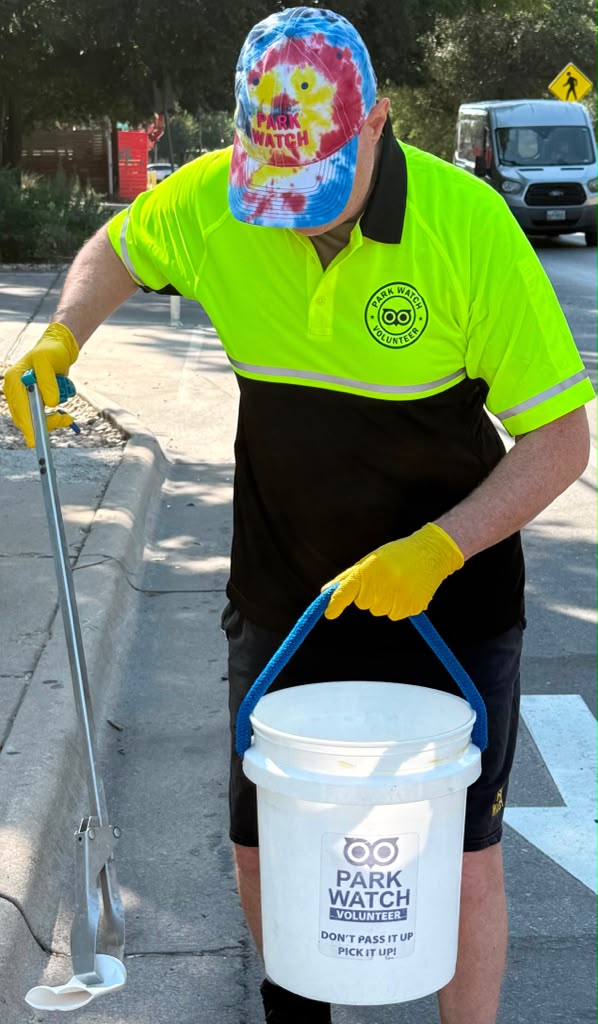
We assemble a volunteer graffiti removal team — G-UNIT — to constantly search for and remove tags from the neighborhood, no matter their size. Big or small, G-UNIT gets rid of them all.
Early on G-UNIT posted before/after images on social media. Big mistake. Recognition raised a tagger's standing with their peers, which just encouraged them to tag more.
By immediately removing tags as they appear — and never posting about the work — G-UNIT proved this quiet approach is the most effective way to stop repeated tagging.
Painting over tags is the least expensive way to remove them, so many property owners prefer it to expensive solvents plus pressure washing and water reclamation. Prefer a custom color on your exterior? Provide the paint — we'll happily use it. Your paint, our labor.
Taggers seek approval from their peers to increase their social standing. Our method uses that against them.
As a general rule, people seek approval from their peers to increase their social standing within the group.
Taggers bring their peers back to the scene of the crime to show off their work and receive praise.
When they arrive and can't find their mark, they're left vulnerable to ridicule from their peers.
The tagger realizes the entire endeavor has been a waste of time, money and credibility.
Now they must decide: return and try again, or move on to unmonitored ground elsewhere.
“Where's your tag?”
“It was right here!”
“Where?!”
Tagger repeatedly points at a section of wall covered in fresh primer.
“THERE!”
Even in the face of rapid removal, younger taggers often return to a monitored area — they don't invest much time or materials.
Older taggers are more likely to move on to unmonitored areas, where their work is less likely to be removed — they invest more time and materials.
For our method to work, the community has to act as our eyes and ears — reporting new tags as soon as they appear.
Before we treat a neighborhood, we recruit, train and equip a dedicated local volunteer — the Block Boss — to find and report new tags after our crew has moved on.
The Block Boss's job is to prevent the neighborhood from returning to its previous condition of lawlessness — by staying alert and reporting fast.
To make this easy, Park Watch provides Block Bosses with virtually unlimited cans of gray & black spray paint. New tags get covered in seconds, with minimal effort.
Removing tags doesn't guarantee taggers won't return — it merely creates another blank canvas to be tagged. And spot-painting over tags leaves a discolored area on what was once a uniformly painted wall.
In our opinion, murals are the best method to hide that discoloration and eliminate a blank canvas altogether.
Austin has many talented artists — but none of them work for free, and property owners may not know where to find them or how to hire them.
Park Watch created Zilker Art Project (ZAP) to find talented artists, introduce them to property owners, and raise the funds needed to hire them.
Contact ZAPReport new tags the moment you see them. Include a photo and the street corner — we'll dispatch a G-UNIT volunteer.